Frequently asked questions
What makes a tree a good candidate for relocation, and when removal is the safer call.
Is your tree suitable for relocation?
Before getting in touch, it helps to understand what makes a tree a good candidate. While we believe in preserving as many trees as possible, a few factors decide whether your tree can be successfully moved.
Size considerations
Most trees can be relocated, but size does matter. Very small specimens like Cycas are generally too delicate for the relocation process, whilst very large palms, including Cocos Palms, Cotton Palms, and Canary Island Palms that have grown beyond a manageable scale, may exceed our equipment capabilities. If you are unsure whether your tree falls within our size range, send us some photos and measurements and we will let you know.
Root zone requirements
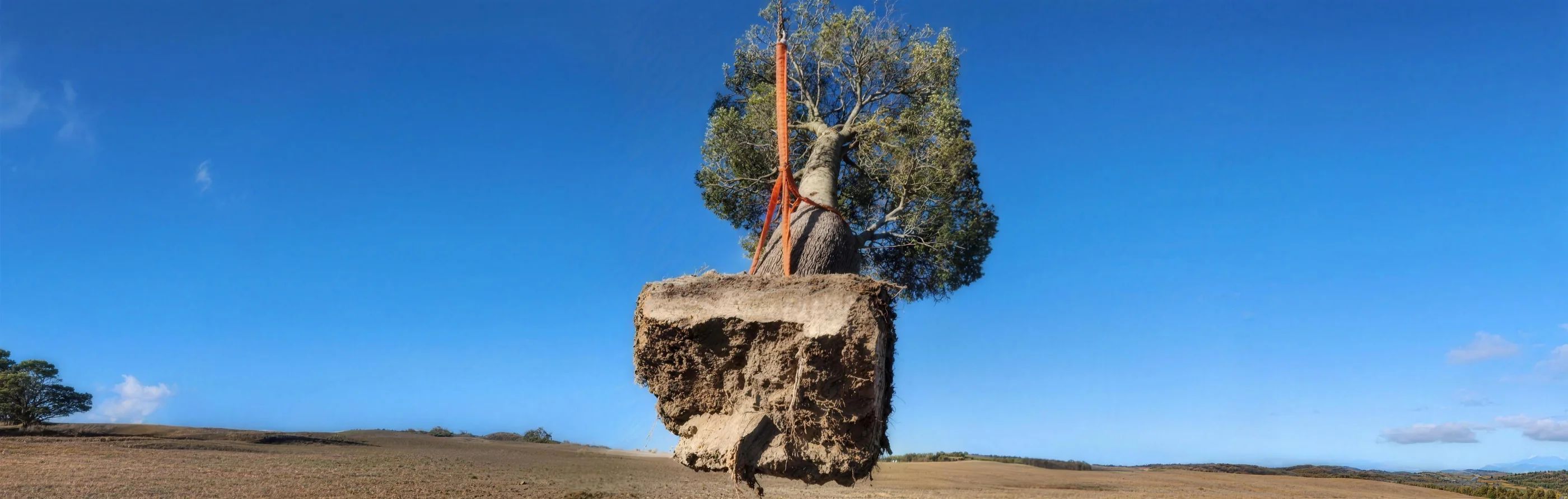
Successful tree relocation depends heavily on preserving a healthy root ball. We typically need at least 1 to 2 metres of clearance around each plant to extract the root system safely. Trees planted too close to buildings, retaining walls, or other structures may not have sufficient root zone access for a successful move.
Site access and safety
Most transplants require access for large machinery, including excavators and cranes. Before we can proceed, we will need to assess whether your site can accommodate this equipment. Underground services and overhead power lines can also create challenges during the extraction stage. This is why it is essential to engage a professional specialist arborist. We ensure all safety requirements are met and risks are properly managed.
Service area
We are proudly based in Toowoomba and prefer to work within a 3 to 4 hour radius of our home base in Withcott. This allows us to provide the hands on, personalised service we are known for. If you are located outside Queensland, unfortunately we may not be able to assist, but feel free to reach out and we will do our best to point you in the right direction.
Reasons for removing a tree
Sometimes relocation is not the answer. These are the situations where removal or remediation is the responsible call.
Dying, diseased, structural failure
Decay in a tree is not always visible from an external inspection, as it progresses to the outer limbs from pith decay in the main trunk. Decay can progress slowly if the tree is left in situ in its natural environment. Physical stresses to the tree, such as relocation or root damage, can accelerate the decay process.
Damage to surrounding structures
Invasive tree roots can undermine foundations and cause damage to structures including piped services.
Construction and renovations
Development sites often require land clearing. Disturbance to a root zone can lead to canopy die back and tree decline. Excavating or undermining the root system to a point which cannot compensate for the size of the tree and the wind sail of the canopy creates a risk of the tree falling. Equipment strike upon bark can lead to a penetration wound, which invites decay and insect infestation.
Storm damage
Lightning and wind can damage limbs and bark, which can lead to ingress of decay and tree decline. When a tree's bark is penetrated or removed, this area can become an entry point for insects or decay, particularly in soft fleshy trees such as Brachychiton rupestris.
Liability and maintenance
By using a VTA, a visual tree assessment, on mature trees, external damage and decay can be detected. The risk of falling limbs increases when decay in the outer limbs reaches a size that affects structural integrity. Limbs considered at risk should be monitored by a qualified arborist on a schedule, with preventative hazard reduction taken as appropriate.
Still wondering about yours?
Send us photos, rough measurements, and where it is. We will tell you straight whether it can be moved.
See if we can move it→